
How Africa Became One Of The World’s Most Powerful Cultural Exporters
Africa is no longer just inspiring global culture. It is manufacturing it at scale, shipping it and creating its own structures and systems that make is sustainable and distinctive. African creators are turning local stories into worldwide obsession. The continent is no longer waiting to be interpreted by the West before it becomes legible to the world, which has been the case for years now. Increasingly, Africa is speaking for itself in its own accents, aesthetics, pacing and emotional language and the world is adjusting accordingly and identifying these creators and their industry for the geniuses they are.
This is the era of made, not borrowed. So much is made here and loved elsewhere, with “elsewhere” increasingly meaning the entire world.
When you really look around contemporary culture, some of the most exciting things happening globally are not adaptations of Western formulas with African seasoning. They are distinctly African products that have altered the direction of media, music, fashion, storytelling and internet culture itself.
Nigeria in particular has been central helping position Africa as a cultural headquarters. Ranked 77th globally in the Brand Finance Global Soft Power Index 2025, Nigeria has climbed 16 places since 2023 and is now Africa’s fourth-highest soft power player after Egypt, South Africa and Morocco.
Another important part of this progression is that much of Africa’s rise has been grassroots-driven: powered by the energy, ambition and creativity of its people.
Of course what immediately comes to everyone’s mind when we talk about this is Afrobeats. The sound of global progression that, thanks to streaming, social media and the internet, took over the world in the 2010s and has continued its worldwide dominance throughout the 2020s, showing no signs of slowing down its cultural imprint.
What started as a distinctly Nigerian sonic ecosystem built from a distinct mix of highlife, Fuji, dancehall, hip-hop and local club culture has become one of the defining sounds of global pop music. Today, artists from everywhere are borrowing its artist, its bounce, percussion patterns and melodic structure. The genre now shapes how global hits are engineered. Take a look at one of Doja Cat’s biggest hits, Woman, it is a purely Afrobeats song made an American artist.
What makes this moment different from previous eras of cultural extraction, though, is that African artists are controlling the export pipeline too.
Burna Boy sells out stadiums globally while making deeply Nigerian music. Tems has become one of the defining voices of modern R&B, even bagging Grammys in non-African categories, while sounding unmistakably Lagosian in emotional texture and cadence. Rema turned “Calm Down” into one of the biggest songs on earth without flattening his sound into something more “international.” The international audience [and the international feature] came to him instead.
This same shift is happening in storytelling.
For decades, Africa largely existed in mainstream global media as short hand for poverty, war, corruption, safari, struggle. The continent was usually used as backdrop rather than a featured protagonist. But now a new generation of African filmmakers, writers and creators are changing not just what stories get told about Africa, but how stories themselves are structured.
We often think of Nollywood being a global media giant solely as a result of being one of the world’s largest producers of movies but this position is not simply because of volume, but because of emotional instinct. Nollywood understands melodrama, intimacy, family tension, aspiration and chaos in ways that resonate deeply across emerging markets globally. It mastered bingeable storytelling before streaming platforms fully understood the assignment.
The Black Book became one of the most watched African films globally on Netflix because it understood the language of political distrust and vengeance thrillers through a Nigerian lens. Blood Sisters showed that African prestige television could be stylish, addictive and globally competitive without losing its cultural texture. But also African actors are shaping global cinema too: actress Nomzamo Mbatha played Mirembe on Paramount‘s Coming 2 America.
A similar story is playing out in fashion. LVMH Prize winner Thebe Magugu is redefining what contemporary African luxury could look like by centering political storytelling and African memory in high fashion while Kenneth Ize has elevated aso-oke weaving traditions into globally respected luxury garments changing and challenging what African looks like. Lagos Fashion Week itself has evolved into one of the most important style incubators in the Global South, producing designers whose work now circulates internationally all without needed Western validation first.
For years, the world engaged with Africa like a moodboard: African sounds, styles, and codes were sampled and used often without an African in the room or credit properly given.
Today, distinctly African creations are moving through the world on their own terms. And it has an independence powered by distinct individual perspectives all moving toward the same goal: exporting African ideas and creations to the largest stages possible for its own worth.
Because the future of culture will not belong to the places with the most resources. It will belong to the places with the strongest perspectives. And increasingly, so much of what is loved by the world will be made right here in Africa.
The Made By Africa, loved By The world 2026 Campaign
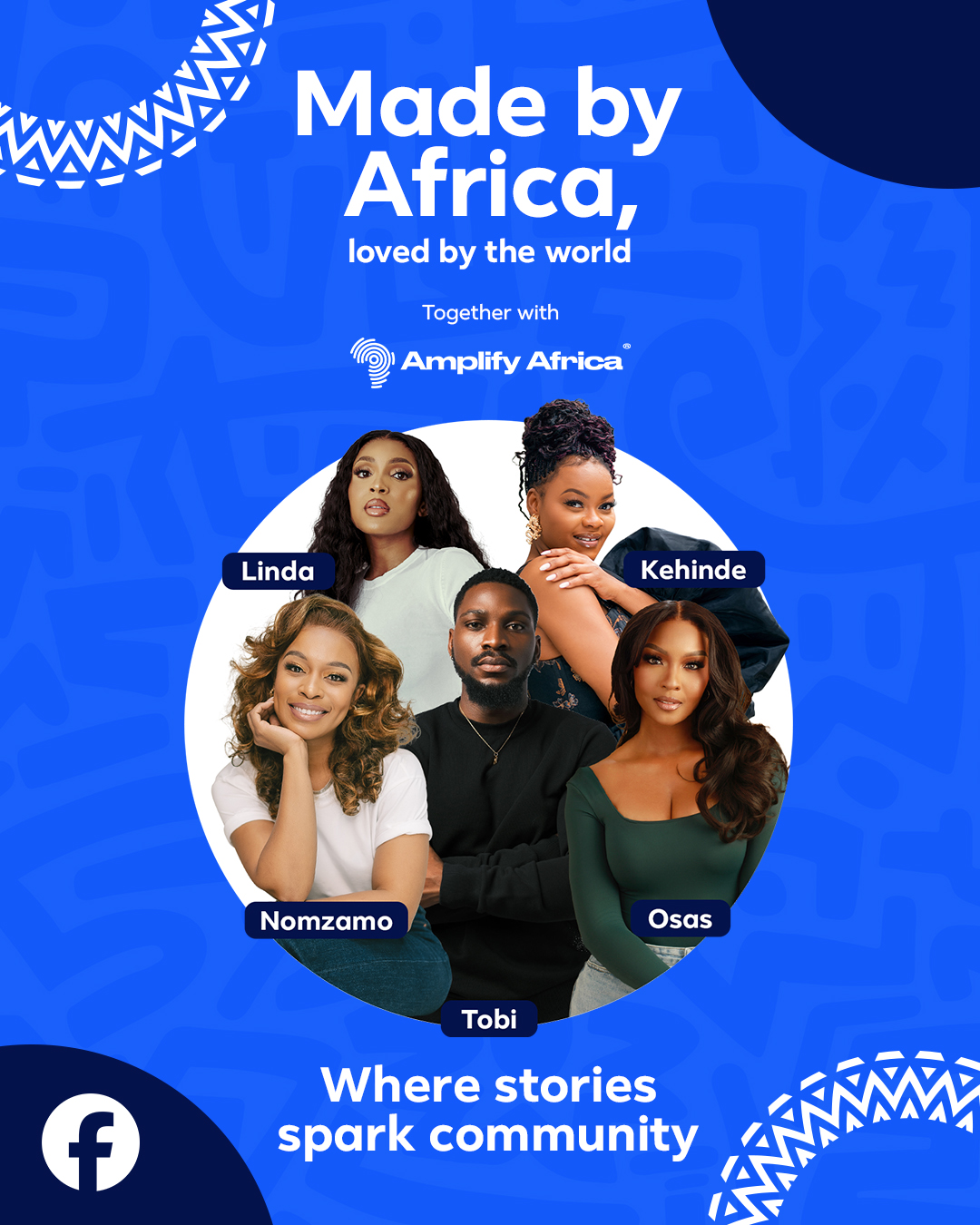
For the sixth edition of its pan-African campaign, Made by Africa, loved by the world: Where stories spark community, Facebook is turning its attention to one of the continent’s most powerful exports: storytelling with a focus on African cinema and the actors, producers and storytellers pushing it onto the global stage.
The campaign spotlights some of the most exciting names shaping film culture across Nigeria and South Africa right now. From Nollywood stars like Kehinde Bankole, Osas Ighodaro and Tobi Bakre to South African powerhouses Nomzamo Mbatha and Linda Mtoba, the series celebrates the talent redefining how African stories travel across the world.
At the center of the campaign is a five-part vodcast series hosted by leading African podcasts I Said What I Said (Nigeria) and Because We Said So (South Africa) featuring conversations with each star, exploring storytelling, identity, community and the impact African film continues to have far beyond the continent. Vodcast snippets will be available on the Meta Africa Facebook page, with full episodes available on the podcast channels.
Amplify Africa is a proud media partner of the Facebook 2026 ‘Made by Africa, loved by the world’ campaign.