
Dakar Fashion Week Turns the Atlantic Ocean Into a Runway
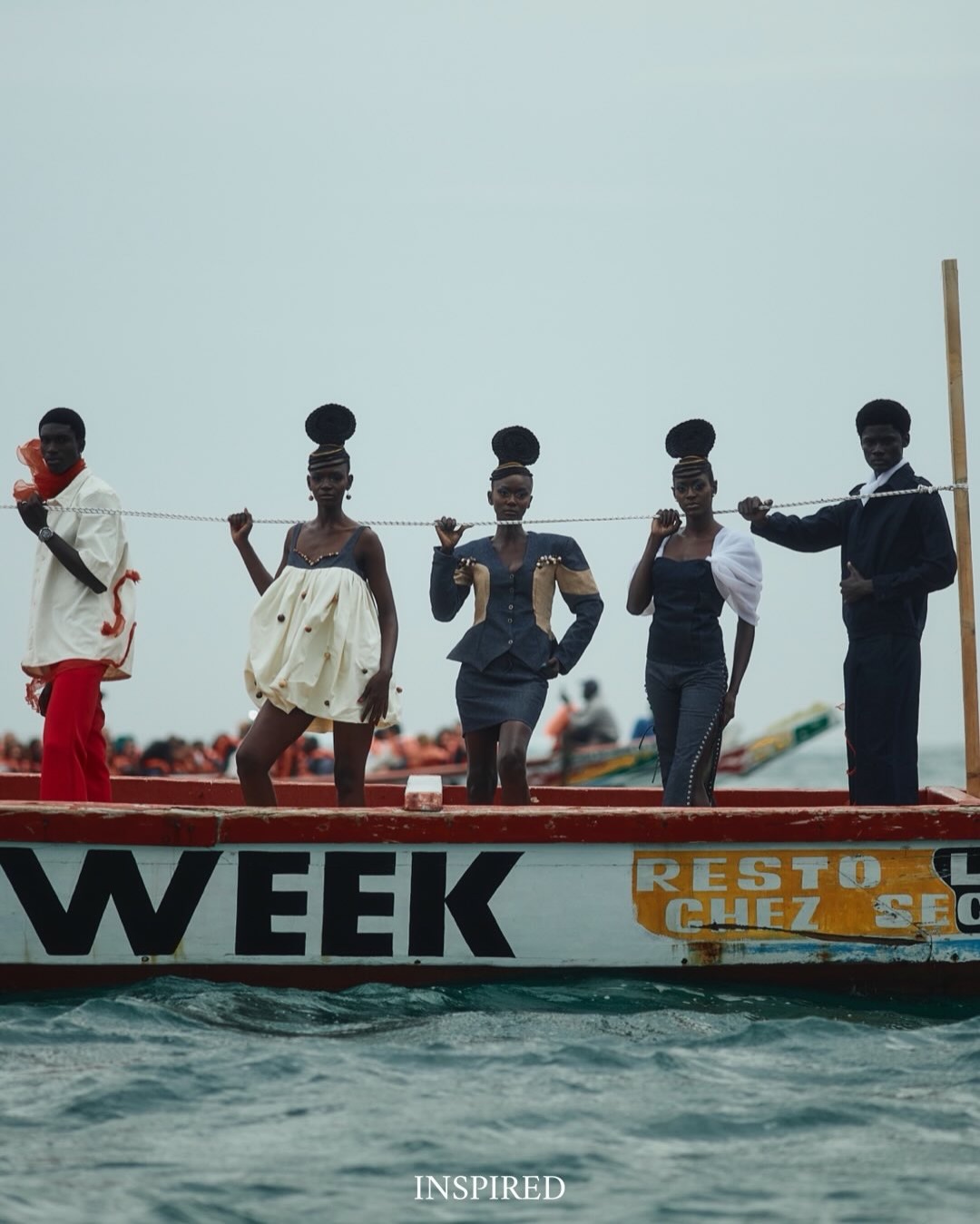
Dakar Fashion Week made waves this year. The 23rd edition closed with a runway staged on the Atlantic Ocean. The fashion festival had models afloat on brightly painted Senegalese fishing boats (Pirogues) off the coast of Dakar.
Instead of a traditional catwalk, the final show unfolded on moving water. Models balanced carefully on ropes while waves lifted and dipped the pirogues beneath them. Fabrics caught the sea breeze. Spectators watched from nearby boats, turning the ocean itself into the venue.
This year’s lineup reflected Dakar Fashion Week’s pan-African reach. Designers came from all over Africa-Senegal, Ghana, Congo, Morocco, and Côte d’Ivoire, alongside a small number of European guests. The collections leaned into craft and place. Handwoven textiles, natural fibers, cowries, raffia, and flowing cottons dominated the runway. Some designers worked with sharp tailoring inspired by traditional dress. Others focused on softer silhouettes shaped by movement and wind, letting the setting guide the clothes.
Founded in 2002 by Adama Paris, Dakar Fashion Week has always framed fashion as culture first. Over the years, it has grown into one of West Africa’s most visible fashion platforms, offering African designers space to show work rooted in lived experience. By staging the final runway on the ocean, the festival reinforced that position without overexplaining it.
The choice of the Atlantic carried weight. In Dakar, the sea represents labor, migration, memory, and survival. Fishing boats have long carried stories alongside nets. Placing fashion on those boats shifted the runway from a neutral stage to a site of meaning. The setting did not distract from the clothes. It sharpened their message.
An Inspiration For Fashion Show
This year’s edition also challenged what a fashion week setting is expected to look like. There were no enclosed halls or controlled lighting. Movement came from waves, not stage direction. The result felt grounded and intentional, rather than staged for spectacle alone.
As images from the ocean runway continue to circulate, Dakar Fashion Week leaves a larger question behind. If a runway can exist on water, shaped by culture and environment, how else might fashion weeks rethink space, access, and storytelling going forward.